

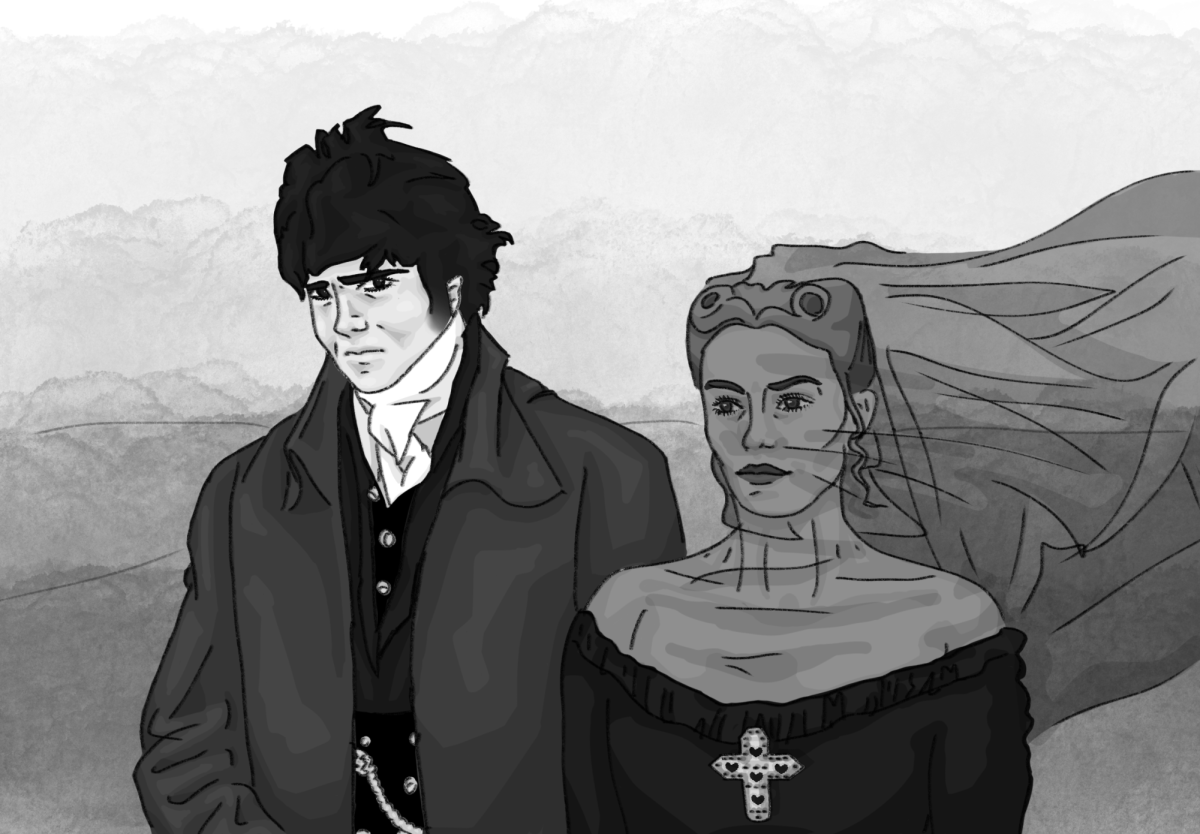
On February 14, director Emerald Fennell released her fifth movie to date, Wuthering Heights. After following the oh-so-popular Saltburn, Fennell has a lot to follow up on. Based on the 1847 novel by Emily Brontë, Fennell brings a more modern take on this story. While there are many promising aspects of this movie, from the soundtrack by Charli XCX and lead stars Margot Robbie and Jacob Elordi, the movie falls rather short of the original narrative.
At the start of the movie, we see a young Catherine “Cathy” Earnshaw (Margot Robbie) whose father adopts a young boy that Cathy names Heathcliff, played by Jacob Elordi. The Earnshaws also have a housekeeper named Nelly Dean (Hong Chau), who becomes one of Cathy’s only friends given the seclusion of the house. Growing up, Mr. Earnshaw (Martin Clunes) is a town drunk and has a short temper, which he often takes out on Cathy or Heathcliff. Because of this, the Earnshaws are also relatively poor, which is shown when we see the house, aptly named Wuthering Heights, full of holes in the ceiling and not enough wood to burn a fire. The movie takes place over a long period of time, following their lives as they navigate their love affair.
When Cathy and Heathcliff are around eighteen years old, a new man, Mr. Edgar Linton (Shazad Latif), moves into the house next to Wuthering Heights (although still five miles away). Linton is a very wealthy unmarried man; Cathy sees this as an opportunity to live a more comfortable life. Shortly after sneaking over to Linton’s house, breaking her ankle and earning a stay at his house, she and Linton get married. All while this is happening, there is clear sexual tension between Cathy and Heathcliff, though neither of them likes to flat-out admit it. After some time has passed, Cathy becomes pregnant with Linton’s child, and Heathcliff returns back to Wuthering Heights, eventually buying the property after the death of Mr. Earnshaw. Cathy and Heathcliff fall into an affair, which is shown through their numerous sexual encounters throughout the movie. Eventually Cathy admits that they must stop seeing each other since she is married; Heathcliff agrees and goes on to marry Cathy’s friend (and Edgar’s sister) Isabella, played by Alison Oliver, as a way to incite jealousy and rage from Cathy. When this doesn’t work, he makes Isabella write letters to Cathy to try and “rescue her from the evil Heathcliff.” These letters are unknowingly intercepted by Nelly in an attempt to keep Cathy and Heathcliff apart. At the end of the movie, Cathy dies from a disease she contracts while pregnant. In the final scene, we see Heathcliff lying with her dead body, grieving.
For anyone who has read both the book and seen the movie, there are an immense amount of differences between the two; for starters, the movie only covers about half of the book. Not only that, but Fennell tends to focus more on the lust of Cathy and Heathcliff’s relationship rather than the love.
There are many great aspects to the film; the acting is exceptional, providing a very real-feeling relationship between Cathy and Heathcliff. Even the actors who portray young Cathy and young Heathcliff, Charlotte Mellington and Owen Cooper, respectively, were admirable. The film itself is very visually pleasing, with a very realistic set; it truly sends the viewer back into the time period of the 1840s. Along with this, Fennell uses colors in a multitude of ways; Cathy is seen wearing many large dresses, mainly in a bright red color, which could later be interpreted as foreshadowing her untimely and rather gruesome demise. There are also elaborate sets in some scenes, such as when the Lintons decorate their mansion with a winter theme. The contrast in colors from Wuthering Heights to the Linton household conveys the idea of wealth. When Cathy is living at Wuthering Heights, a majority of the sets are a brown or grey color, and it is often raining. When she marries into the Lintons, there is an abundance of colors such as red, blue, pink, and green.
The film itself leaves the viewers with many questions to wonder, some of which are mentioned in the book itself and some of which are not. When Cathy is living with Linton, for example, Heathcliff comes to visit after six years flaunting his newfound wealth. There’s also the question of what happens after the movie ends; while this is answered in the book, the movie completely cuts out the entire second half of the book, which many viewers might be upset about.
For fans of Brontë and the source material, there will likely be very mixed feelings about the film. Fennell offers a very different take on it than the book it’s adapted from. Overall, the film has lots to offer, from the spectacular visuals to the renowned and talented cast, and is certainly worth a watch for all.