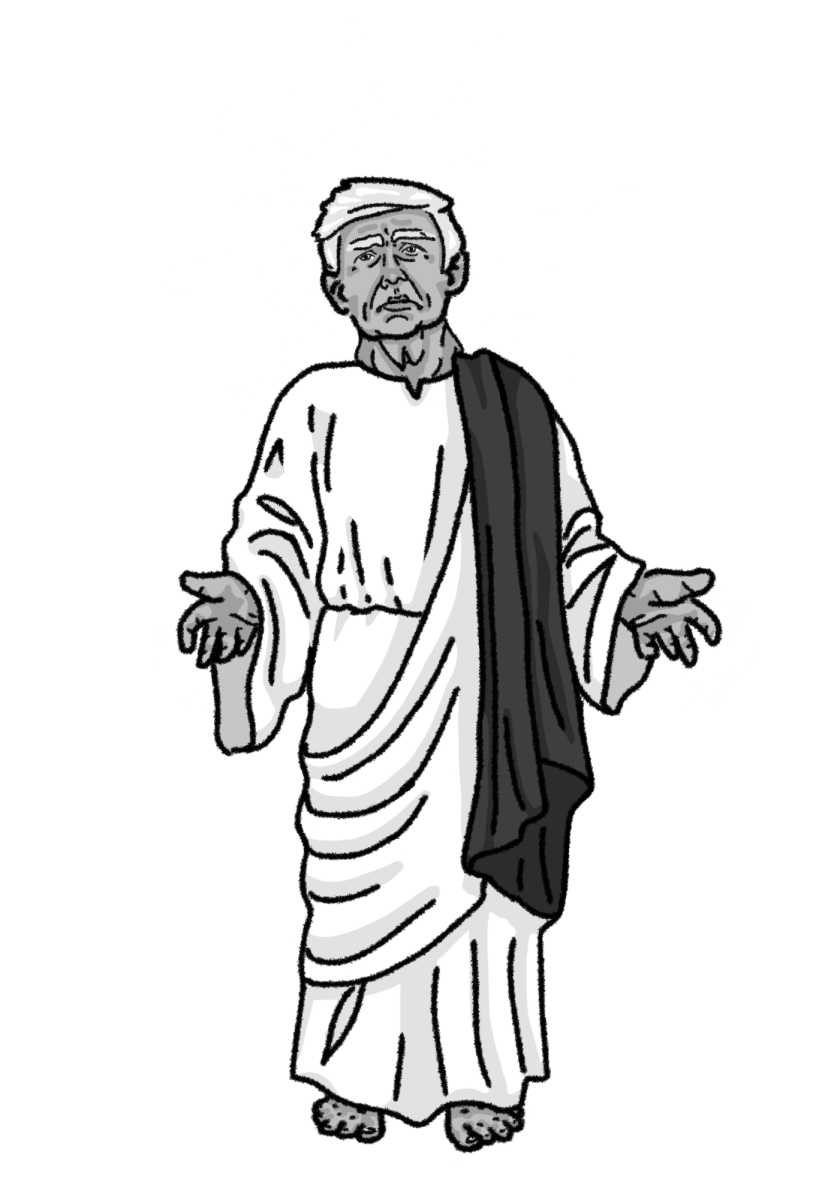

On March 28, over eight million people across the globe participated in No Kings rallies, with over 80,000 protestors in Philadelphia alone. These demonstrations were organized to advocate against the ever-growing threat of monarchy apparent in the Trump Administration, as the President continues to seek unchecked power in the deployment of ICE agents, the overriding of Congress in wartime decisions, and more. Not only do the protests give voters a chance to voice their grievances against current political injustices, but they also put pressure on important figures to change their policies. Beginning when President Donald Trump took office for his second term, the rallies have become a nationwide phenomenon and inspired many people to join Indivisible, the primary organizer behind the events. No Kings demonstrations clearly have a measurable impact in America’s increasingly declining democracy by mobilizing voters and unifying citizens under a common goal to preserve their constitutional rights.
Marching has been a significant aspect of American society since the nation’s founding in 1776, all the way from the Stamp Act protests to the civil rights movement. Protests signal to politicians that the public is unhappy about current events and bring pressing causes to their attention, often leading to change in national norms or legislation. For example, the environmental protests of the 70s put extreme pressure on the executive and legislative branches of the government, leading to the founding of the Environmental Protection Agency. In 2017, the Women’s March became another instance of mass mobilization, by inspiring a record-breaking 10,000 women to express interest in running for office, creating a “pink surge” in government institutions. These prominent marches have had significant impacts on the establishment of No Kings, which was orchestrated by the 50501 movement—a nationwide grassroots initiative backed by the motto “50 protests, 50 states, 1 movement.” No Kings is also centered around the No Kings Act (S. 4973), which asserts that no power or person in the government is above U.S. law.
Furthermore, large demonstrations create unity among citizens, bringing those together who have aligned values and political goals. Indivisible members have expressed that the objectives of the No Kings protests are largely to support abortion access, voting rights, and gun control—uniting millions of people who also strongly espouse such causes. Lisa Erbes, long-term member of Indivisible and organizer of the rallies, highlighted the importance of involvement in an interview for The Washington Post, saying, “if we can’t curb this rising authoritarianism, we’re never going to be able to fix those issues.” Since the beginning of Trump’s second term, the number of local Indivisible chapters has grown by 150 percent nationwide, and there are now more than 2,700 Indivisible groups across the U.S. In accordance with this, Harvard University professor Erica Chenoweth has stated that when even 3.5 percent of a nation’s population comes together in peaceful protest at a key moment, it likely will become a much larger, or broad, movement. This is extremely important in modern politics because it means that the government will be significantly more prone to listen to the demonstrators’ voices; they are no longer as capable of scaring or dividing them. The No Kings protests strive to meet this standard, causing tangible change to occur.
Not only do protests inspire people to get involved and cause current government officials to change their ways, but they also sway voters to demonstrate their grievances at the polls, typically electing different change-makers. According to a study conducted by Stanford University, “a wave of liberal protesting in a congressional district can increase a Democratic candidate’s vote share by 2% and reduce a GOP candidate’s share by 6%,” and a wave of conservative protests would likely reduce the Democratic vote share by two percent and increase the Republican share by six percent. With the midterm elections on the horizon, it is more important now than ever for the Democrats to unite voters. Even though the Republicans currently control both the executive and legislative branch, the No Kings Protests—held in both blue states and deeply Republican areas—are a hopeful sign that disagreements with the Trump Administration will be reflected in the upcoming elections. Because clearly, protests do have an impact on the choices voters make at the polls, and the No Kings rallies are no exception.
The Trump Administration has shown a severe lack of support for these demonstrations, publicly sharing feelings of hostility on social media and other platforms. After No Kings Day in October 2025, Trump called the protests “a joke” and said that the people involved “[are] not representative of this country.” He also posted an AI video of feces being dumped on protesters, which exemplifies a serious lack of immaturity that no previous executive has shown before. Additionally, House Speaker Mike Johnson labeled the events “hate America rallies.” Although these reactions may seem disheartening, it is imperative that protestors do not get discouraged — especially in the face of the hatred pouring out of the Trump Administration. Surrendering one’s voice to backlash will only encourage the government to keep committing even more injustices, and signal that they can easily stop criticism through just attacking protestors back. But on the other hand, by continuing to push the Administration, even if they seemingly aren’t open to change, those barriers will be broken and a difference can be made.
While some commenters online argue that the demonstrations are pointless and that words, or mere “strong condemnations,” do not hold enough power to make a real difference in the government, the open expression of beliefs is never pointless, and its effects are visible in many ways. Now, it is of the utmost importance to remain politically active and use your voice; ignorance and neglect will only make matters worse. In the words of the No Kings organizers, “this country does not belong to kings, dictators, or tyrants. It belongs to We the People—the people who care, who show up, and who fight for dignity, a life we can afford, and real opportunity.” So, make that “silly” sign, or join a protest, because in this democracy, every voice matters—and we must fight to keep that right.