
Over the course of the past academic year, LM’s Model United Nations program has undergone one of its most expansive seasons in recent history. Marked by the delegation’s first overnight national conference and participation in regional events, members are hopeful the program will end with a bang at LM Model UN’s upcoming home conference available to all LM students.
The first milestone of the season came with the delegation’s attendance at the Princeton Model United Nations Conference, hosted at Princeton University. The three-day trip marked a significant expansion for the program, which in recent years had primarily focused on in-district events. Delegates participated in committees examining topics such as climate change, as well as playing historical figures in the Russian Revolution and the Ides of March. Delegates from all over the world were in attendance, including Canada, Honduras, and even New Zealand. Participating in a committee on semiconductors, co-president Lincoln Doolittle ’26 said it “is going to play a profound role in all of our futures” and that “being able to debate and collaborate… was what made it so fun and a window into a possible career in policymaking.” Delegates participating started working weeks in advance; Thomas Powell ’26, who represented Greece in a topic on Ukrainian military support, “did hours of research, which really paid off.”
Regional conferences, nonetheless, continued to shape the season. RAMMUNC, Harriton High School’s Model UN conference, provided delegates the opportunity to compete alongside their friends in both present-day committees and historical committees, where delegates could represent leaders during the Algerian Revolution. Co-president Ma’ayan Kline ’28 represented Canada in a committee examining cyber warfare, saying “It was a great experience.” The number of differing roles and perspectives at the conference presented delegates representing opposing interests a challenge to collaborate and compromise. “You’re talking about issues that are directly affecting people,” according to co-president Alexa Weatherwax ’27. “You’re learning how to solve these problems with people who potentially disagree with you.”
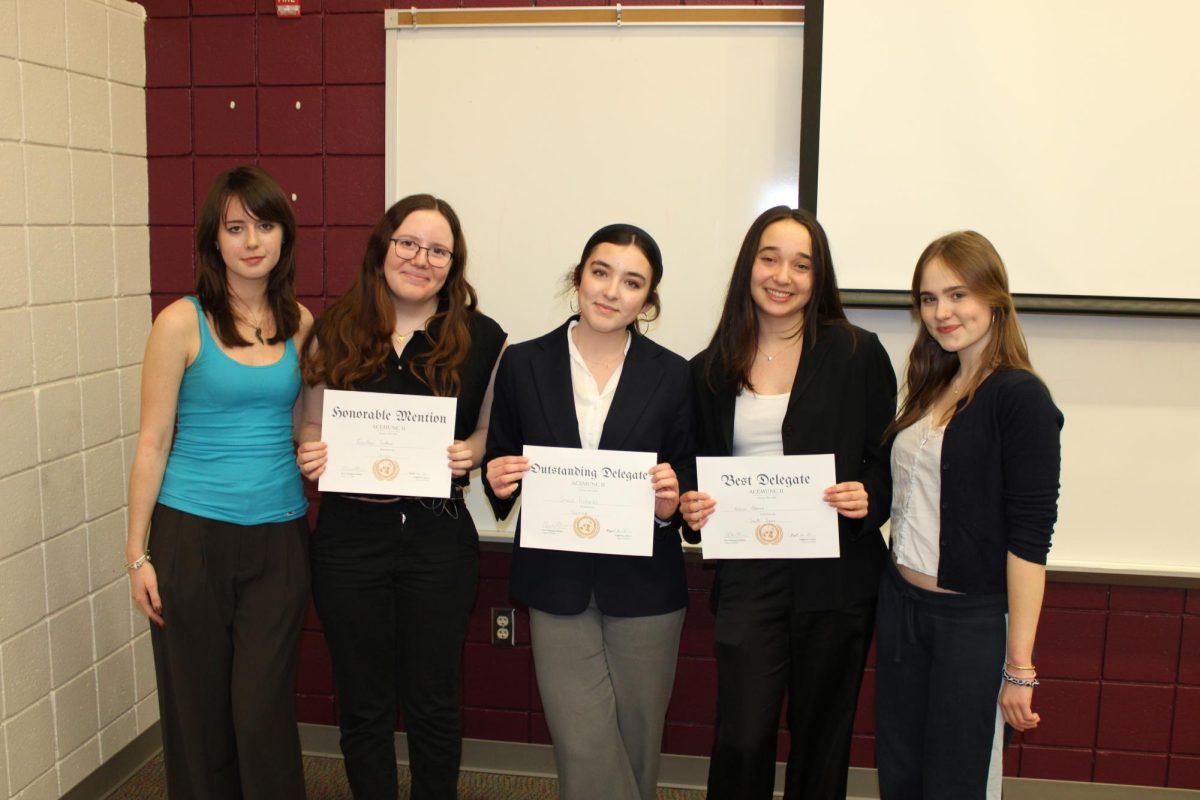
The program’s efforts recently culminated at ACEMUNC, a conference staffed and attended extensively by LM students. With over fifty participating, the event stood out for its high number of first-time delegates. Powell chaired a historical committee regarding the Chernobyl disaster and observed the progression of newer participants over the course of the day, saying that “by the end everybody seemed interested and engaged.” Lincoln Doolittle ’26 said the organizational process itself was among his favorite experiences this year. “When you spend so much time with people working toward something and it actually happens,” he said, “that’s when you know the club has done something meaningful.” Gerard Wilk ’27 participated as backroom staff for the first time, helping manage developments that shaped committee outcomes in real time, commenting that “it was really interesting to see what actually happens and help the conference move.” Weatherwax, who also helped organize and judge The Hunger Games Committee, commended the direct engagement at the conference. “You’re really face to face with these people in your room,” she said. “You come in with your ideas and you’re just talking about what your character believes.” Kailin Wang ’29, who won an award representing Cecelia in The Hunger Games, described ACEMUNC as “very community-oriented and so much fun.”
Beyond conferences, delegates described Model UN as an activity that offers preparation extending well beyond high school classrooms. Students frequently pointed to research, public speaking, and collaboration as skills that translate directly into academic and professional environments. Powell said the process of preparing position papers and drafting resolutions mirrors the type of writing expected in higher education. “As someone wanting to study History and Political Science in university,” said Powell, “Model UN has really given me a way to combine the two effectively in a fun way. It effectively combines the historical research and knowledge aspects with the understanding and study of why leaders do what they do, what the goals for countries are, and how the intricacies of politics work.” Co-president Parker Kleinman ’26 added that Model UN had helped him grow as a person in addition to giving him skills to excel in a professional environment. “After six years in Model UN, I’m still not an extrovert, but speaking to new people is much easier and no longer feels like a barrier. Model UN has also improved my writing. My grammar has gotten stronger, and my essay writing and persuasive skills have improved through writing position papers, resolutions, and speeches. It’s also helped me write my college essays, based on the persuasive elements I learned in Model UN.”
At the same time, delegates said that the most lasting impressions of the season developed outside of formal debate—instead around the shared experiences surrounding conferences. According to Kleinman, “In my first conference, which took place in Washington D.C., I met a student at another school who I’ve kept in contact with and have seen many times since, inside and outside of Model UN. The people in the club are amazing and have changed my life in countless ways. It’s made me a better person who cares more about the world, and I’ve met tons of people with common interests.” Overnight travel and extended conference days became highlights as the season progressed. Josh Katz ’27, who represented India in a topic on clean energy at Princeton, said the experience “was lots of fun” and that he “got to swim…, hang out with friends in a hotel, and meet lots of new and interesting people.” For many delegates, the friendships formed through shared preparation and competition became inseparable from the academic experience itself. Kline, speaking about her experience in a committee on artificial intelligence weaponry at Princeton said, “It was a great trip, and I met some really cool people and learned a lot about diplomacy and collaboration in a more competitive environment.”
Planning for LMMUNC, LM’s largest home conference of the year scheduled for April 11, has since become the central focus of the closing season. Kleinman, one of the students organizing the event, describes it as a “conference of firsts” that will culminate LM Model UN’s most eventful season since its conception. This year’s theme, “No Kings,” will bring new topics about modern-day authoritarianism, how it grows, how it changes, and how it can be stopped. For the first time in over half a decade, the conference will operate as a full-day weekend event, a change organizers believe will more closely resemble collegiate Model UN experiences while giving newer delegates more room to settle into debate and develop ideas. According to Doolittle, “At LMMUNC II, six years ago, I competed at a conference that was on a Saturday. And it was my first real experience getting out there and feeling what an entire day of Model UN could actually feel like. And so I’m really excited to see that format back at LMMUNC, which is a function of all the hard work that’s being put on behind the scenes by the officers and by our advisor Micheal Kelly and also our school for allowing us to have these opportunities.” The conference will also mark the first time schools from outside the district have been formally invited, with delegations expected from Radnor High School as well as Harriton High School, Bala Cynwyd Middle School, and Black Rock Middle School. Committees themselves reflect that expansion: high school delegates will debate the future of Venezuela centered on a developing crisis appearing in international headlines, participate in an imaginative Alice in Wonderland Committee where they can represent different factions within the story, or enter the Napoleonic Wars and balance between diplomacy, military strategy, and rapidly evolving crises across Europe. Kleinman, who authored the background guide for the Napoleonic Wars historical committee and will judge the session, described the opportunity as personally meaningful, saying he is “very excited to chair a committee that I am very interested in.” According to Weatherwax, another organizer, the topics also reflect current world problems and events, saying that “the committee on Venezuela is literally what is going on right now and something that everybody’s seen on the news and everybody’s talking about.”
As LMMUNC comes closer, those in the club said that watching both the program and each other grow has been the true highlight of the season. For students considering participation, Wilk said the best approach is simply to try it. “Just go to a couple meetings, go to one conference and see if you like it,” he said, adding that joining Model UN during middle school helped make that year “one of the best school years I’ve ever had.”